
Understanding How Hebrew Verbs Work
When accessing information about verbs throughout our Old Testament concordances, you'll find numerous references to Hebrew verb tenses such as Qal or Hiphil. The following list identifies each verb tense and it's part in speech via a comparative example in English using the verb "to love."
Simple Hebrew
- Qal (active) - he loved
- Niphal (passive) - he was loved
Intensive Hebrew
Giving force or emphasis; emphasizing ("very" in the "very same man" is an intensive adverb)
- Piel (active) - he loved indeed! / he loved excessively
- Pual (passive) - he was indeed loved / he was loved excessively
- Hithpael (reflexive) - he loved himself
Causative Hebrew
Expressing causation, as certain verbs (fell is a causative verb meaning to cause to fall)
- Hiphil (active) - he caused to love
- Hophal (passive) - he was caused to love
For more information, please refer to the parsing button for the word that interests you to access more detailed information:
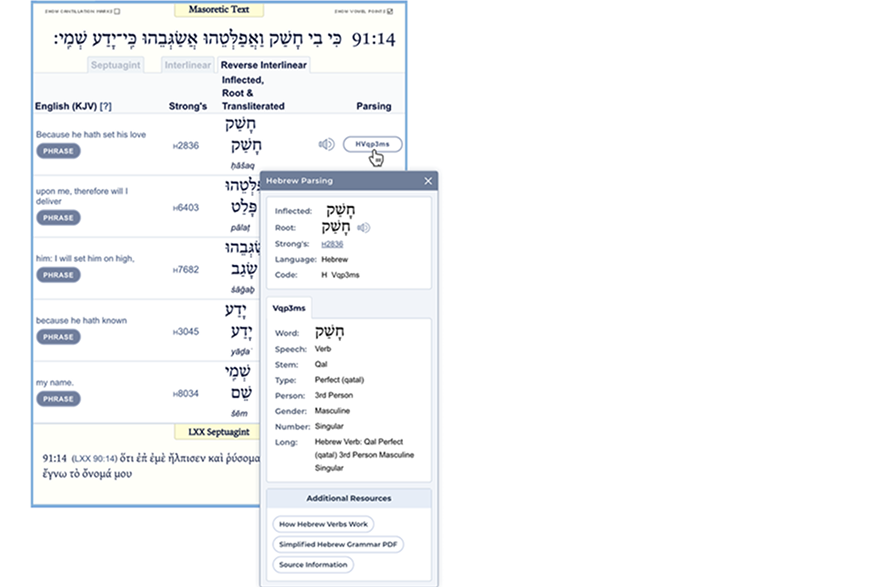
Refer to the Hebrew Grammar for more in depth information on understanding parts of speech.